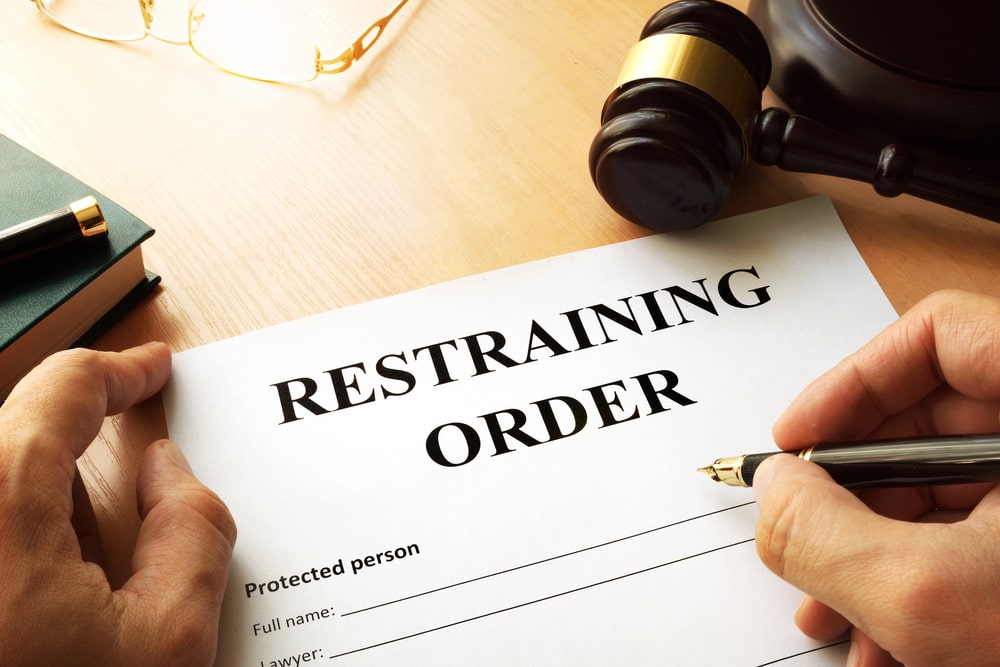
A restraining order is a court order that is meant to protect an individual in Orange County against harassment, abuse, threats, or stalking. It may seem like just a simple document, but a restraining order is a legally binding order with significant consequences for both the person seeking protection and the individual being restrained. In California, restraining orders are regulated by the laws in the Code of Civil Procedure, the Family Code, and the Penal Code. These statutes describe the various categories of protective orders, how one may obtain one, and the consequences of violating the order.
It is critical to know the functions of these orders if you are seeking protection and have been served with one. They can significantly influence personal safety, family relations, and legal rights.
At the Goldman Flores Restraining Order Law Firm, our restraining order attorneys are ready to assist you in understanding your rights and the legal process of a restraining order and defend you.
An Overview of a California Restraining Order
A restraining order is a judge’s order that restricts one person’s behavior to protect the safety and peace of another. A court imposing a restraining order establishes a legally binding boundary between two parties and specifies clear rules that must be followed, with the threat of legal action for violations.
This legal instrument aims to avoid further damage by preventing actions in advance and establishing a secure space between the people involved. The first step in valuing the power and scope of these orders is to understand the particular elements of these orders.
Identifying the Restrained and the Protected Parties
These legal terms refer to specific roles in a restraining order. The individual seeking the court's protection is the protected person or the petitioner. This is the person who has been harassed, abused, or threatened and is seeking the court to intervene.
On the other hand, the individual who is the subject of the order sought and obliged to comply with the terms of the order is called the restrained person or the respondent. Both parties are named explicitly in the order, and the terms of the order are legally enforceable on the restrained individual, subject to criminal prosecution in case of any breach.
Personal Conduct Orders
One of the key elements of almost any restraining order is the personal conduct orders. These are certain restrictions that do not allow the restrained individual to perform specific actions against the individual who is being safeguarded.
A judge will order the restrained party to avoid a broad range of actions, which usually involve stalking, harassing, threatening, or using violence. This ban is not limited to actual physical contact. It also includes any kind of communication; the restrained individual is not allowed to call, text, email, or communicate with the protected individual via social media or by using third parties. The aim is to establish a total absence of contact to avoid intimidation or abuse.
Stay-Away and Move-Out Orders
Besides the personal conduct restrictions, the restraining orders almost always contain stay-away orders. Such orders require the restrained individual to keep a certain physical distance between themselves and the protected person and their children's home, workplace, and schools or day care facilities.
This distance is often established at 100 yards, but a judge can change it depending on the case circumstances. If the parties cohabit, especially in domestic violence cases, a judge may grant a move-out order or residence exclusion. This strong order compels the restrained individual to vacate the everyday dwelling instantly, even though their name appears on the lease or deed to guarantee the security of the individual being safeguarded.
Types of Restraining Orders
California law acknowledges that threats and harassment may emanate from any form of relationship and, as such, it offers several different types of restraining orders. All types are specific to a particular relational situation and vary in legal requirements to obtain them.
The selection of the appropriate kind of order is a critical initial step of the legal process because it defines the type of evidence required and the extent of the protections provided. These orders do not fit in a one-size-fits-all category; they are specifically tailored to the specifics of domestic violence, civil harassment, elderly abuse, and workplace disputes.
Domestic Violence Restraining Order (DVRO)
A Domestic Violence Restraining Order, or DVRO, is intended to be used in circumstances when the person being safeguarded has a close relationship with the person being restrained. This involves married, divorced, separated, dating, and those who used to date.
It also includes individuals living together or having lived together and close relatives like a parent, child, sibling, or grandparent. To receive a DVRO, you have to prove to the court that you have experienced abuse, and the definition of abuse under California law is comprehensive and can encompass not only physical harm but also emotional and psychological harm, such as threatening someone, stalking them, or disrupting their peace. The level of evidence is that of a preponderance of the evidence, that is, it is more probable than not that the abuse has occurred.
Civil Harassment Restraining Order (CHRO)
A Civil Harassment Restraining Order, also known as CHRO, is the right choice when the individual who harmed you is not a spouse or a close relative. This restraining order aims at conflicts between neighbors, colleagues, flatmates, or strangers.
Unlawful violence, a threat of violence that is credible, or a course of conduct that annoys, alarms, or harasses another person seriously and has no legitimate purpose are the types of harassment that fall under this category.
Both Domestic Violence Restraining Orders (DVROs) and Civil Harassment Restraining Orders (CHROs) require proof by a preponderance of the evidence, meaning it must be more likely than not that the alleged conduct occurred. However, if the violation involves a legally protected activity, the judge may require clear and convincing evidence to grant you this order.
Elder or Dependent Adult Abuse Restraining Order
The Elder or Dependent Adult Abuse Restraining Order offers California residents special protection to the most vulnerable groups. This order is targeted at those individuals who are 65 years or older, or those adults aged 18 to 64 years with some physical or mental disability that impedes them from protecting themselves.
This kind of order may be requested to avoid physical abuse, financial abuse, neglect, abandonment, or any other deprivation by a caregiver or any other person. The process is made more accessible so that the elders and dependent adults can promptly obtain protection when they are in danger of harm.
Violence at Workplace: Restraining Order
The peculiarity of a Workplace Violence Restraining Order is that it is not requested by the individual employee but by their employer. In case an employee has been subjected to unlawful violence or there is a reasonable fear of such violence in the workplace, the employer can request the court to issue an order to protect such an employee during their employment.
This order may involve the restrained individual leaving the workplace and stopping all contact with the employee. This legal instrument gives an employer the power to initiate proactive measures to ensure a secure workplace for the whole workforce when a single employee is being targeted.
The Procedure of Obtaining a Restraining Order
The process of obtaining a restraining order is a formal legal procedure that starts with submitting a formal request to the court and ends with a hearing, during which a judge renders a final verdict.
This journey aims to offer instant protection to the endangered individuals and ensure that the restrained individual can give their side of the story. To go through these steps, paying attention to detail, observing strict deadlines, and presenting the facts clearly is necessary. Every step, from the preliminary paperwork to the last hearing, is crucial to the final decision of the case.
Submitting the Preliminary Paperwork
It starts with you, the petitioner, filling out and handing the court clerk a series of necessary legal forms. These forms request that you give specific information concerning the individual you seek protection against and explain, as much as possible, the instances of abuse, harassment, or threats that have taken place.
You must draft a sworn statement about why you fear for your safety and why the order is required. This preliminary use is your initial chance to convince the judge of your case; thus, the information must be clear, precise, and persuasive.
The Temporary Restraining Order (TRO)
Once you have submitted your paperwork, a judge will hear it, typically between 24 and 48 hours, in an ex parte hearing, meaning the person you are restraining is not present.
If the judge, based on what you have written, concludes that there is a threat of imminent harm, they will issue a Temporary Restraining Order, or TRO. This order is legally valid immediately and in the short term once it is formally delivered to the restrained individual by someone other than you. The TRO typically lasts between 21 and 25 days until the scheduled hearing date, or until the formal court hearing can occur.
The Permanent Restraining Order Hearing
The TRO will specify a date and time of a formal court hearing, when you and the restrained person will have to appear. During this hearing, you can both present your case before the judge.
This includes providing evidence, testifying, presenting evidence like photographs, text messages, or police reports, and calling witnesses. The judge will then hear both parties and determine whether to grant a permanent restraining order. Despite its name, this order is not permanent. It may last up to five years and be renewed before expiration to offer long-term protection to the petitioner.
Effects of a Restraining Order
The consequences of issuing a restraining order are profound and far-reaching to the restrained individual and go much further than the immediate limitations of contact and movement.
It is a grave civil court order that can significantly and permanently affect many aspects of a person's life, such as their personal freedoms, career prospects, and parental rights. Such consequences cannot be underestimated because they may impose long-term obstacles and legal duties that can change an individual's future direction.
Influence on Personal and Professional Life
A restraining order is a public record, and once it is granted, it will appear on most background checks. This may pose significant challenges in most spheres of life. As an example, prospective employers might be unwilling to employ a person who has a restraining order on their record, as they will perceive it as a manifestation of possible conflict or instability.
Also, landlords can reject a housing application due to fear for the safety of other tenants. The order may also put specific professional licenses at risk, particularly in fields that require a high level of public trust. The stigma that comes with a restraining order may haunt an individual for years after the order has lapsed.
Firearm Restrictions
Federal and California state law dictate that, under the influence of some kinds of restraining orders, most prominently a DVRO, an automatic ban on gun possession is imposed. This implies that the restrained individual should sell or surrender by the next day all the guns they possess to a licensed dealer or law enforcement agency.
They are also prohibited by law from buying or otherwise obtaining any firearms during the whole period of the restraining order. This is a firm and no-compromise penalty that is aimed at minimizing the possibility of deadly violence in unstable circumstances. Breach of this gun prohibition is a distinct criminal offense that is punishable with harshness.
Implications on Child Custody and Visitation
The presence of a restraining order can have a drastic impact on the child custody and visitation orders when children are involved. The law establishes a rebuttable presumption in domestic violence cases that it is not in the best interest of a child that the restrained person be granted sole or joint custody.
This implies that the judge will give custody to the parent who is being protected unless the restrained parent has substantial evidence to counter this assumption. The right to visit can also be severely limited, and the court can direct that all visits are professionally supervised, or in other instances, the court may refuse visitation altogether to protect the safety of the children.
How to Respond to a Restraining Order
Obtaining a restraining order may be a confusing and frightening experience. It is a legal procedure that requires your prompt attention and a careful reaction. Disobeying the order or not showing up at the scheduled court hearing is not an option and will definitely lead to the judge issuing the permanent order against you.
It is essential to know what your rights are and what you must do to bring your side of the story across. You have only a chance to combat the accusations and to avoid the grave outcomes of a long-term order with a strategic and well-thought-out response.
Understanding the Notice
You will be given some documents, which contain the Temporary Restraining Order and a Notice of Court Hearing, when you are served. You must read all the pages of these documents attentively. The TRO will contain the exact regulations that you will need to comply with at once, including no contact with the petitioner and avoiding certain places.
The Notice of Hearing will tell you the date, time, and place of the court hearing at which a judge will rule whether to grant the permanent order. These are your formal notice of the case against you, and they include time limits by which you must comply should you want to submit a written response.
Building a Defense Strategy
You can defend yourself during the court hearing if you disagree with the allegations in the restraining order request. This includes coming up with a clear and consistent defense strategy. You can claim that the petitioner has fabricated or inflated their own claims, and provide your evidence and witness testimony to refute their story.
The other typical strategy is to show that the evidence they have provided is not enough to satisfy the legal standard that they need in the particular kind of restraining order they are seeking.
It can also be effective to present your own counter-evidence, such as emails or text messages indicating a different context for your communications, to challenge the version of events offered by the petitioner.
Breach of a Restraining Order
A restraining order is not just a recommendation; it is an order issued by a court of law. The intentional violation of its terms is a grave crime that has serious legal consequences. California law considers the breach of a protective order as a criminal offense, independent and distinct from the underlying behavior that resulted in the issuance of the order in the first place.
It is crucial to realize the seriousness of wrongdoing to the restrained individual because one misstep will result in an arrest, criminal charges, and long-term effects that increase the challenges already placed on the individual by the civil order.
Penalties for Violating a Restraining Order
California PC 273.6 makes it illegal to knowingly and intentionally violate restraining orders. It can be charged as a misdemeanor or, in aggravated cases, a felony that involves knowingly and intentionally violating restraining orders.
To obtain a conviction, a prosecutor has to demonstrate that there was a valid order, that you knew about the order, and that you knowingly violated one of the provisions of the order. A first-time offense that does not involve physical injury is generally subject to a maximum of 1 year in jail and a maximum fine of up to $1,000.
Nevertheless, in case an act of violence accompanies the violation or when you have a history of violating a restraining order, the punishment can be much more brutal, and you may face felony charges and a prison sentence. Every violation is a crime in itself, so that several criminal charges may be made in case of several acts of non-compliance.
The Reason Why You Should Have a Qualified Attorney
The legal process can be daunting and confusing, whether you are trying to get the safety of a restraining order or trying to defend yourself against one. Rules of evidence, court procedures, and legal standards are not always intuitive, and one wrong step can affect your life permanently.
The stakes are incredibly high, as they concern your own safety, your freedom of movement, your reputation, and even your relations with your children. Going through this complex legal process without professional help is risky and can jeopardize your case.
Maneuvering through the Complex Legal System
A professional restraining order lawyer knows the complexities of the legal system. They are aware of the types of forms to be submitted, the admissibility of evidence, and how to have a convincing case before a judge.
A lawyer may assist a petitioner in collecting and systematizing the evidence required to make a solid case as to why the order is needed. To a respondent, an attorney may examine the assertions of the petitioner, find the weak points in their evidence, and develop a strong defense strategy to safeguard you against false or exaggerated claims. Their experience may mean the difference between a successful result and a disastrous one.
Defending Your Rights and Future
After all, the job of an experienced lawyer is to represent you and to defend your rights and your future with all their heart. They make sure that they listen to your side of the story and that the evidence is brought out in the best manner possible.
A lawyer will assist you in knowing all your options and making wise decisions throughout the entire process. In a case with such far-reaching and potentially life-altering outcomes, having an experienced and dedicated legal professional by your side provides not only a strategic advantage but also invaluable reassurance during what is often an extremely stressful process.
Find an Efficient Orange County Restraining Order Attorney Near Me
Restraining orders are effective instruments that are designed to safeguard people against abuse, harassment, or reasonable threats of violence. They are able to offer short-term relief by issuing a Temporary Restraining Order and long-term protection by issuing a permanent order. Since restraining orders involve strict legal standards and carry serious consequences for the restrained individual, including limits on personal freedom and professional opportunities, they must be handled with great care.
It is essential to have a reliable lawyer, whether you are protecting yourself or your family or defending against claims that may impact your future. To obtain expert advice and professional assistance in Orange County, contact the Goldman Flores Restraining Order Law Firm at 714-333-0699 to ensure your rights are not violated and you can go through the restraining order process smoothly.